
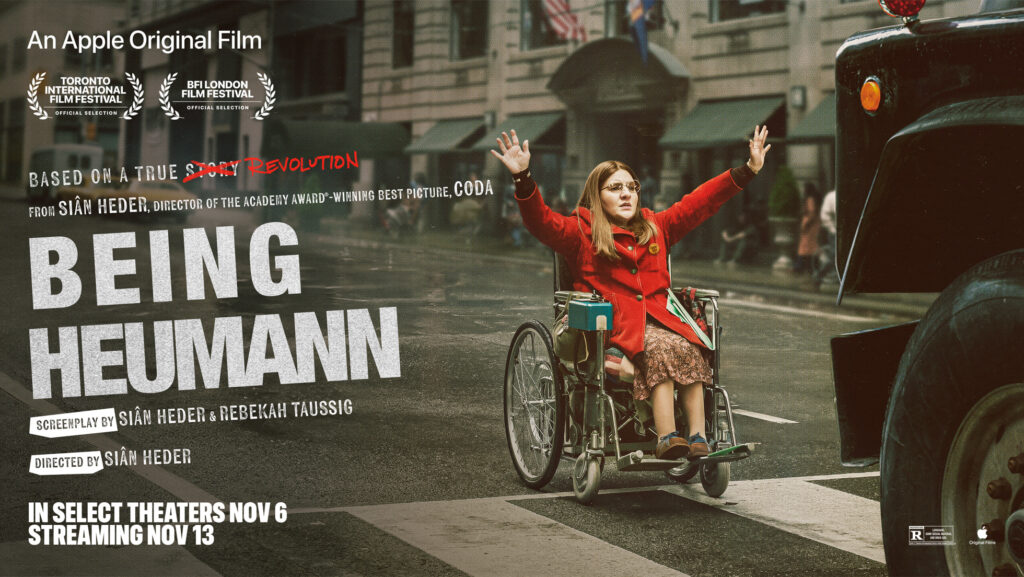
Being Heumann, the new film adapted from Judy Heumann’s memoir of the same name, is a Major Motion Picture: think drama, comedy, romance, sex, and a killer soundtrack, all set against the turning tide of history. Produced by Apple Original Films, and directed by Oscar-winner Sian Herder, it is also a cinematic benchmark: Being Heumann is the first major studio film led by a cast of more than a dozen disabled actors.
The film focuses on the 1977 504 Sit-in, when Heumann, Kitty Cone, Brad Lomax, Hale Zukas and more than 100 fellow disabled activists held The San Francisco Federal Building for nearly a month, pulling off the longest peaceful occupation of a federal building in US history. The sit-in at Federal, home to the regional offices of the United States Department of Health, Education and Welfare (HEW), forced HEW Secretary Joseph Califano to sign and enforce Section 504 of the Rehabilitation Act of 1973, the nation’s first disability-focused civil rights legislation, which forbids any program receiving federal funds from discriminating on the basis of disability.
The film’s wide ensemble cast, featuring Ruth Madeley (Judy), Madeline Delp (Kitty), Antwan Tolliver (Brad) and Andrew Pilkington (Hale), is what makes the movie, and the protest, successful. We see how many people, and how many different kinds of expertise and resources, it takes to hold the building: When the government cuts the building’s phone lines, Deaf protesters sign through the windows; when the Feds cut the building’s water supply and try to starve the protesters out, Brad and other Black disabled activists connect with the Black Panthers, who arrive daily from Oakland with trays of food; when a delegation of protestors leave for Washington to exert additional pressure on Califano, the local machinists’ union helps provide moving vans, because the trucks have ramps and enough space for multiple wheelchairs.
Did you know about this moment in American History, when more than a hundred self-described Radical Crips, with support from the Panthers and local unions, held it down until they forced the hand of the federal government? I didn’t, and I’ve benefited directly from 504.
Stories aren’t widely known unless they’re widely told. That’s why it’s thrilling to see this history brought to film, especially in the streaming era, because mass media means a wide audience, which is what this story deserves.
The churning of history makes this film exciting, but the film’s granular focus on the protesters’ daily experience makes it luminous. This film shines because it is an inside story: Most of the action takes place inside the building during the sit-in. We’re in the room with the protesters, so we witness disabled adults as they are rarely portrayed on film: As multi-dimentional human beings, talking to each other, laughing, joking, sleeping together, strategizing, arguing, and organizing, aware of their goals and their bodies. We see Kitty creating make-shift medication refrigerators on the building’s air conditioning units as fellow protesters set up a sex tent in the hallway. We see protesters eating chips and bumming cigarettes. We see Judy misspell a protest sign, and suddenly everyone has Disibili-Titties.
Disabili-Titties and specific, varied, needs. The film does not shy away, or cut away, from the experience of care: we see on screen when Judy is lifted into and out of her chair; we also see, on screen, when she directs a lover to get her chair. “I’m going to tell you what I want,” she says. “And you’re going to do what I say.” Right.
The film’s portrayal of disability stands out for its joy and humor and tenderness, and for its conviction, as Hale puts it, that “disability is not a tragedy. It is a tremendous hassle” when the world is inaccessible. We see on screen that it is both thrilling, and really, really hard to hold a federal office building day after day after day. To have to wash your hair in the sink, and contend with bomb threats, and find someone to kick down the wall of a tiny bathroom stall so it becomes accessible.
Holding out takes a toll, but the protesters are adamant that they won’t leave the building. I didn’t want to, either. It is a pleasure, as a viewer, to be in the room with the protesters, spending time in a room full of disabled people talking to each other.
I had the opportunity to watch this movie in a room full of fellow disabled people, at a preview screening presented by ReelAbilities, the world’s premier cinematic hub for film by, about, and starring disabled actors, writers, directors and producers. The screening was a total scene, drawing disabled creatives from across the entertainment industry. A knowing camaraderie in the theater punctuated the beats of the film. I enjoyed laughing when everyone was laughing (“Disabili-Titties”), and hissing when everyone was hissing (“Inspiring!”)
As I keep saying, I enjoyed being in the room. Ultimately, being in the room is the point of Section 504. The law recognizes Disabled Americans’ right to access spaces and services that receive public funds. That means the right to exist in public, including in public schools, public parks, public transit, and public buildings.
Existing in public means not only the right to education, housing, jobs, and medical services, but also the right to be part of society, which is the right to talk and laugh and build relationships with other people, rather than be forced into isolation by inaccessible environments: The right to an accessible bus is the right to go across town to see a friend; the right to an accessible picnic table is the right to share a meal in the park with your favorite people.
Simply, access is about what gets you in the room. Life is about what you do once you’re inside. It’s so nice to be in the room with the protesters, and see disabled life on screen.