
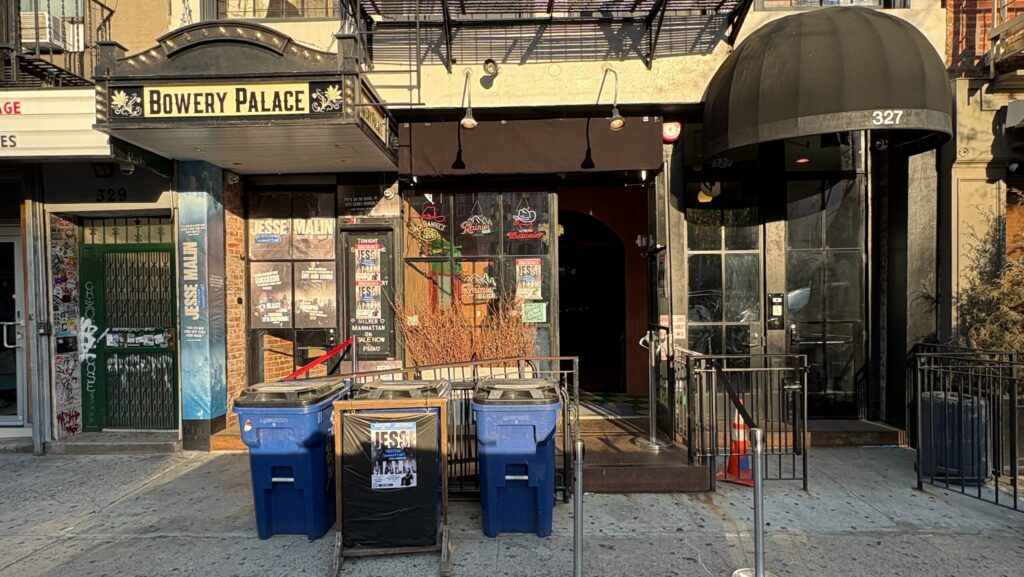
Jesse Malin’s Punk Rock concert-play, Silver Manhattan, which recently wrapped an extended run at Bowery Palace (327 Bowery), is one of the best pieces of art about disability and chronic pain I have ever seen. It is a beautiful musical autobiography, and a great New York story: Malin name-checks Whitestone and Douglaston as frequently as CBGB’s and MSG.
During the show, Malin notes the “near-religious experience” he had his first time on stage. At Silver Manhattan, the power he describes is clearly in the house: you can see Malin is an innately gifted performer. You can feel how he electrifies the place. As he recounts his early life, it’s obvious he was a rock star when he was jerry-rigging his first electric guitar as a kid in Whitestone.
That’s the point of the show: He’s a rock star. Always has been. Always will be. He’s also Disabled. In 2023, Malin experienced a life-changing spinal stroke which paralyzed him from the waist down. Silver Manhattan interweaves Malin’s journey growing up in Queens, and finding his place in New York’s Punk and Hard Core scenes, with the story of his sudden stroke, and painstaking experience of rehabilitation. The show charts his journey to get on stage, and his effort to get back on stage. Rock Star. Disabled. Rock Star. Disabled Rock Star.
Malin says he’s seen a lot of things, but one thing he’s never seen is a rock frontman in a wheelchair. Thanks to Jesse Malin, thanks to Silver Manhattan, I have seen that. The question Silver Manhattan asks, and more interestingly, answers, is, what does that look like?
The venue is part of the answer. Bowery Palace is a rock venue on the Bowery. True to form, it’s dark and cramped, with garbage cans out front. When I arrived, I thought, Am I in the right place? How are they gonna do this show here?
Here’s how: Malin is carried on stage on a stretcher.
One of the show’s producers, Thomas Kriegsmann, has noted that the stretcher was Malin’s idea. His creative choice. I’d say creative in the sense that Disabled people are people who find creative ways to navigate environments that present barriers: Here is a venue with stairs, and the stretcher is a creative way to surmount them. Kriegsmann, who’s more Punk Rock than me, gets the creative lore better than I do: remember Iggy Pop carried off stage in a coffin? The stretcher is Punk Rock, and seeing Malin enter on the stretcher is seeing an artist at work.
The stretcher is also a stretcher. Silver Manhattan is exceptionally frank about disability, and the pain, rage, grief, shame and alienation of being in a hospital, being made into an object, being separated from one’s body, one’s agency, and one’s sense of self. This show is beautiful because of the music. It’s stunning because of the soundscape, which includes both guitar riffs and hospital beeping.
I’m not a rock star, but I am Disabled. I have Cerebral Palsy (I walk with a limp, but without mobility aids). I can’t play guitar, but I’ve heard enough hospital beeping to feel nauseous at the sound: Once, handed a catcher’s face mask from a box of sports equipment in elementary school gym class, I didn’t want to hold it, much less wear it. “It smells like anaesthesia,” I said, because that was the strongest association I had with wearing a mask over my nose and mouth.
Regarding hospitals, the actor George Robinson, who uses a wheelchair, makes the excellent point, “when you’ve been in a clinical environment for a long time, you start to associate yourself with that place… It’s so important to be able to see yourself beyond that context.”
When I told a friend, who also identifies as Disabled, that I had seen Silver Manhattan, and thought it was exceptional, I said, “I’m sort of glad the venue wasn’t ‘obviously’ accessible.”
I don’t mean for a second that I want venues to be inaccessible or difficult to navigate. I meant I was glad to see Malin perform a rock show in a venue that looked like a rock club, and not like a hospital.
If a hospital palate is bright whites and bright lights, Rock music has long offered an invitation to Paint It Black. For that reason, Jesse Malin’s Silver Manhattan, performed in a rock club, offers potent lessons in the aesthetics of access.
Consider common public opposition to accessibility improvements, and it’s clear that access and aesthetics are inextricably linked: A lot of people don’t want access ramps, for example, installed on beloved public buildings, because they think the ramps are ugly.
People ask, “why is this ugly ramp here?”
Instead, we should ask, “why is this ramp – this wonderful, useful, necessary ramp that makes it easier for everyone to use this building – ugly? Why haven’t we designed access improvements that are as beautiful as the buildings they improve?”
Quality is a mark of equality. Access improvements should be designed with the same level of attention and care as any other building feature. If you wouldn’t design an ugly entrance, don’t design an ugly entrance ramp.
Further – Silver Manhattan shines on this point – aesthetics are important to access because thinking of aesthetics means thinking of individual identity, taste and expression. In Silver Manhattan, Malin makes an aside about making sure his hat is “perfectly crooked.” He’s a self-described “aging punk,” and that’s his look.
Limiting access improvements to the hospital palate of white and beige and metal and plastic says, “Your look doesn’t matter. You’re Disabled. Disabled people don’t have looks. They have ugly l ramps.”
Disabled people are people, so they have looks. An accessible rock venue is a rock venue, so it should look like one. Ideally, a rock venue serves up sweat and sex and danger and release. If the ramp doesn’t match that brief, design one that does. The question is not “why is this ramp ugly?” It’s, “where are the Punk Rock ramps?”
Accessibility means equal access to space, and equal access to life, which means equal access to sweat and sex and danger and release. I am advocating for sexy, Punk Rock access improvements, not only because I’d personally appreciate them, but also, because at the end of the day, I am a clear-eyed businessperson, and aesthetics is branding, and branding is business: The cooler it looks, the more people want in. Equal access means more people get in. More people packing the house. More tickets sold. More merch bought. More money in your pocket.
Since cool accessibility interventions are inherently lucrative, go all out: Maybe there’s more than one ramp at the club. Maybe there’s a VIP ramp at the club! Maybe people are popping bottles at the accessible tables.
If more access means more patrons, that means more people amped up, and turned on. That’s really Rock and Roll. In short, access is Punk Rock. So, when you introduce access improvements at your venue, please, think about painting them black.